
VLSI Design Engineer
Accelerate Your Design Career - Build Innovate Master
Course Duration
480 Hrs
Course Overview
Key Features
- Extensive practical work with industry-standard EDA tools (e.g., Cadence, Synopsys, Mentor Graphics).
- Focused support to help you land your dream job in the VLSI domain.
-
Taught by certified professionals and industry mentors
- Build a strong portfolio through mini and capstone projects.
Skills Covered
- Digital Design Fundamentals
- Hardware Description Languages (HDLs)
- Functional Verification
- Industry Standard Tools (EDA)
- Scripting & Automation
- Problem-Solving & Debugging
Course Curriculum
Rooman IT Ignite
- Module 1 – Python Programming
- Module 2 – Networking Essentials
- Module 3 – Linux Basics
- Module 4 – Cyber Security
- Module 5 – Introduction to Cloud Computing
- Module 6 – Data Analytics
- Module 7 – Gen AI Tools and Usage
Module 1 - Python Programming
- Introduction to Python and Basic Syntax Understand Python installation, syntax rules, and writing your first program.
- Control Structures Learn decision-making (if/else), loops (for, while), and flow control techniques.
- Functions Define and call functions, understand parameters, return values, and scope.
- Data Structures Work with lists, tuples, dictionaries, and sets for real-world data manipulation.
- File Handling Read, write, and manage text and CSV files using Python.
- Modules & Libraries Import built-in and custom modules; explore popular libraries like math, datetime, etc.
- Exception Handling Handle errors gracefully using try-except blocks, raising exceptions, and best practices.
- Object-Oriented Programming Learn classes, objects, inheritance, polymorphism, and encapsulation in Python.
- Python programming with Databases Connect to databases (e.g., SQLite, MySQL), perform CRUD operations using Python.
- Hands-On Practice and Hands On Guided Project Apply concepts through coding exercises, quizzes, and a mentor-led capstone project.
Module 2 - Networking Essentials
- Introduction to Networking Understand the basics of computer networks, types (LAN, WAN, MAN), and networking devices like routers, switches, hubs, etc.
- TCP/IP Model and IP Addressing Explore the layers of the TCP/IP model and learn about IPv4/IPv6 addressing schemes and classes.
- Subnetting and DHCP Learn how to calculate subnets, subnet masks, and understand how DHCP automates IP assignment.
- Application Layer Protocol Study key protocols like HTTP, FTP, DNS, SMTP, and how they function within the TCP/IP model.
- Network Troubleshooting and Basic Security Get introduced to common network issues, diagnostic tools (ping, traceroute), and foundational security practices like firewalls, antivirus, and access control.
- Introduction to OSI Layer Learn the 7-layer OSI model that standardizes network communication from physical to application level.
- Transmission Medium Explore different mediums like cables, fiber optics, and wireless used to transmit data across networks.
- Topology Study network layouts such as star, bus, ring, and mesh and how they affect performance and reliability.
- Ranges of Classes Explore IP address classes (A, B, C, etc.) and their usage based on the size and scope of networks.
- Wireless Technology Learn how Wi-Fi and other wireless standards work to enable cable-free connectivity.
- IPv4 Study the widely used 32-bit IP addressing system and its limitations in modern networking.
- IPv6 Understand the advanced 128-bit addressing system designed to replace IPv4 with greater scalability.
Module 3 - Linux Basics
- Introduction of Linux
- Linux Graphical User Interface
- Accessing the Command Lines
- Working with Files Managing Local Users and Groups
- Controlling Access to Files
- Monitoring and Managing Linux Processes
- Managing Software Packages
- Managing Basic Storage
- Managing Logical Volumes
- Controlling the Boot Process
- Managing Network settings
- Linux Fundamentals and Basic Administration
- System Administration
- Security and Scripting
- RHCA Specific Topics and Introduction to Cloud Computing
Module 4 - Cyber Security
- Intro to Cyber Security Understand the core principles of cybersecurity, its importance, and key concepts like CIA Triad (Confidentiality, Integrity, Availability).
- Cyber Attacks Learn about common threats including malware, phishing, DoS/DDoS attacks, ransomware, and social engineering.
- Security Devices (Firewall, IDS, IPS) Explore how firewalls, Intrusion Detection Systems (IDS), and Intrusion Prevention Systems (IPS) protect networks and systems.
- OS Hardening Secure your OS through user account controls, patch management, disabling unnecessary services, and enforcing security policies.
- Web & Application Security Basics Gain foundational knowledge on securing web applications, understanding vulnerabilities like XSS, SQL injection, and the OWASP Top 10.
Module 5 - Introduction to Cloud Computing
- Introduction to Cloud Computing Learn the fundamentals of cloud computing, deployment models (Public, Private, Hybrid), and service models (IaaS, PaaS, SaaS).
- Core Cloud Services Explore key services such as compute (EC2), storage (S3), networking (VPC), and databases (RDS) offered by major cloud providers like AWS, Azure, or GCP.
- Introduction to Cloud DevOps Understand the principles of DevOps, CI/CD pipelines, Infrastructure as Code (IaC), and automation tools like Docker, Jenkins, and Terraform.
- Advanced Cloud Computing Dive deeper into cloud architecture, security best practices, monitoring, load balancing, auto-scaling, and multi-cloud strategies.
- Hands-on Guided Project Work on real-world projects simulating production environments, with mentorship on choosing roles like Cloud Engineer, DevOps Engineer, or SRE.
- Career Pathways and Hands-On Labs Practice skills in real cloud environments using sandboxed labs for deploying, securing, and managing cloud infrastructure.
Module 6 - Data Analytics
- Introduction to Data Analysis and Tools Learn the fundamentals of data analytics, its applications, and key tools used by professionals (Excel, SQL, Power BI, Python, etc.).
- Data Cleaning and Preprocessing Understand how to handle missing data, remove duplicates, normalize formats, and prepare raw data for analysis.
- Advanced Excel Master pivot tables, advanced formulas, charts, lookups, and data modeling techniques for actionable insights.
- Power BI Build interactive dashboards, create visual reports, and connect to multiple data sources for dynamic business intelligence.
Module 7 - Gen AI Tools and Usage
- Introduction to GenAI & Prompt Engineering Understand the fundamentals of Generative AI, including how large language models (LLMs) like GPT work. Learn the basics of crafting effective prompts to guide AI responses for different tasks.
- ChatGPT for Learning Explore how to use ChatGPT as a smart learning companion — for explaining concepts, summarizing topics, solving doubts, and preparing for interviews or assignments.
- Coding & Research Leverage GenAI tools to write, debug, and understand code more efficiently. Discover how AI can assist in research, documentation, and rapid prototyping.
- GitHub Copilot & Code Assistants Gain hands-on experience with tools like GitHub Copilot, Tabnine, and other AI-powered code assistants to boost productivity, write better code, and speed up development
- Prompt Engineering Deep Dive for Coding Master advanced prompt techniques specifically tailored for coding tasks — such as generating algorithms, refactoring code, translating languages, or writing test cases effectively with AI tools.
- Introduction to Python and Basic Syntax
- Control Structures
- Functions
- Data Structures
- File Handling
- Modules
- Libraries
- Exception Handling
- Object-Oriented Programming
- Python programming with Databases
- Hands-On Practice
- Hands On Guided Project
- Introduction to Networking
- TCP/IP Model and IP Addressing
- Subnetting and DHCP
- Application Layer Protocol
- Network Troubleshooting
- Basic Security
- Introduction to Linux and Basic Commands
- User and File Permissions Management
- Process Management
- Shell Scripting Basics
- Package Management
- Disk Management
- Networking Basics
- System Monitoring
- Intro to Cyber Security
- Cyber Attacks
- Security Devices (Firewall, IDS, IPS)
- OS Hardening
- Web & Application Security Basics
- Introduction to Cloud Computing
- Core Cloud Services
- Introduction to Cloud DevOps
- Advanced Cloud Computing
- Hands-on Guided Project
- Career Pathways
- Hands-On Labs
- Introduction to Data Analysis and Tools
- Data Cleaning and Preprocessing
- Advanced Excel
- Power BI
- Introduction to GenAI & Prompt Engineering
- ChatGPT for Learning
- Coding & Research
- GitHub Copilot & Code Assistants
- Prompt Engineering Deep Dive for Coding
Core Foundation
- Module 1 – Digital Electronics & Logic Design
- Module 2 – CMOS Fundamentals
- Module 3 – Timing and Synchronization Concepts
- Module 4 – Verilog HDL Basics
- Module 5 – Linux & Scripting Essentials
Module 1 - Digital Electronics & Logic Design
- Number systems & binary arithmetic Understand binary, octal, hexadecimal systems and perform arithmetic operations crucial for digital logic design and computing.
- Boolean algebra and simplification Master logic expressions and simplify circuits using Boolean laws and Karnaugh Maps for efficient hardware design.
- Combinational logic design (MUX, DEMUX, Decoder, Encoder, Adders) Design and implement combinational circuits including multiplexers, encoders, decoders, and binary adders for digital systems.
- Sequential circuits (Flip-flops, Counters, Shift Registers) Explore memory-based logic circuits using flip-flops to build counters, registers, and timing devices in digital designs.
- Finite State Machines (Moore, Mealy models) Develop and analyze sequential logic through FSMs to design control units and pattern detectors using state transition diagrams.
Module 2 - CMOS Fundamentals
- CMOS technology overview Understand the basics of Complementary Metal-Oxide Semiconductor (CMOS) technology used in modern digital IC fabrication.
- CMOS inverter characteristics Analyze voltage transfer characteristics, switching thresholds, and propagation delay in CMOS inverters—the building blocks of digital logic.
- Static and dynamic power dissipation Learn how CMOS circuits consume power during steady state and switching, and techniques to minimize energy usage in VLSI designs.
- Noise margins and sizing Study how to ensure circuit stability by evaluating noise margins and proper transistor sizing for performance and reliability.
- Stick diagrams and layout basics Develop layout awareness through stick diagrams and understand how CMOS design translates from circuit to silicon using design rules.
Module 3 - Timing and Synchronization Concepts
- Setup and hold time Learn the critical timing constraints that ensure proper data capture in sequential circuits, preventing logic errors and instability.
- Propagation delay, skew, and jitter Understand the delays in signal transmission, timing mismatches between paths (skew), and variations in clock signals (jitter) that impact high-speed digital design.
- Metastability and synchronizers Explore how metastability occurs in asynchronous clock domains and how to design synchronizer circuits to ensure reliable data transfer.
Module 4 - Verilog HDL Basics
- Verilog syntax and semantics Get introduced to the structure of Verilog code, including modules, ports, and simulation constructs for digital design.
- Data types, operators, and expressions Understand how to declare and use various data types and operators to write efficient and accurate hardware descriptions.
- Behavioral, Dataflow, and Structural modeling Learn the three primary coding styles in Verilog to represent hardware at different abstraction levels.
- Writing testbenches and simulation Develop testbenches to simulate and verify Verilog designs using waveform viewers and simulation tools.
- FSM design using Verilog Model finite state machines (Moore/Mealy) using Verilog to implement control logic and sequential circuits.
Module 5 - Linux & Scripting Essentials
- Linux shell commands and scripting Gain proficiency with essential Linux shell commands and learn to automate tasks using shell scripting for development and deployment environments.
- File handling and directory structures Understand file permissions, directory navigation, and scripting techniques for organizing and managing files efficiently in a Linux system.
- Introduction to Python for automation Learn Python fundamentals to automate repetitive tasks, manage files, and interact with system processes in an engineering environment.
- TCL scripting basics Get introduced to Tool Command Language (TCL) for automating EDA tools and enhancing productivity in semiconductor workflows.
- Number systems & binary arithmetic Understand binary, octal, hexadecimal systems and perform arithmetic operations crucial for digital logic design and computing.
- Boolean algebra and simplification Master logic expressions and simplify circuits using Boolean laws and Karnaugh Maps for efficient hardware design.
- Combinational logic design (MUX, DEMUX, Decoder, Encoder, Adders) Design and implement combinational circuits including multiplexers, encoders, decoders, and binary adders for digital systems.
- Sequential circuits (Flip-flops, Counters, Shift Registers) Explore memory-based logic circuits using flip-flops to build counters, registers, and timing devices in digital designs.
- Finite State Machines (Moore, Mealy models) Develop and analyze sequential logic through FSMs to design control units and pattern detectors using state transition diagrams.
- CMOS technology overview Understand the basics of Complementary Metal-Oxide Semiconductor (CMOS) technology used in modern digital IC fabrication.
- CMOS inverter characteristics Analyze voltage transfer characteristics, switching thresholds, and propagation delay in CMOS inverters—the building blocks of digital logic.
- Static and dynamic power dissipation Learn how CMOS circuits consume power during steady state and switching, and techniques to minimize energy usage in VLSI designs.
- Noise margins and sizing Study how to ensure circuit stability by evaluating noise margins and proper transistor sizing for performance and reliability.
- Stick diagrams and layout basics Develop layout awareness through stick diagrams and understand how CMOS design translates from circuit to silicon using design rules.
- Setup and hold time Learn the critical timing constraints that ensure proper data capture in sequential circuits, preventing logic errors and instability.
- Propagation delay, skew, and jitter Understand the delays in signal transmission, timing mismatches between paths (skew), and variations in clock signals (jitter) that impact high-speed digital design.
- Metastability and synchronizers Explore how metastability occurs in asynchronous clock domains and how to design synchronizer circuits to ensure reliable data transfer.
- Verilog syntax and semantics Get introduced to the structure of Verilog code, including modules, ports, and simulation constructs for digital design.
- Data types, operators, and expressions Understand how to declare and use various data types and operators to write efficient and accurate hardware descriptions.
- Behavioral, Dataflow, and Structural modeling Learn the three primary coding styles in Verilog to represent hardware at different abstraction levels.
- Writing testbenches and simulation Develop testbenches to simulate and verify Verilog designs using waveform viewers and simulation tools.
- FSM design using Verilog Model finite state machines (Moore/Mealy) using Verilog to implement control logic and sequential circuits.
- Linux shell commands and scripting Gain proficiency with essential Linux shell commands and learn to automate tasks using shell scripting for development and deployment environments.
- File handling and directory structures Understand file permissions, directory navigation, and scripting techniques for organizing and managing files efficiently in a Linux system.
- Introduction to Python for automation Learn Python fundamentals to automate repetitive tasks, manage files, and interact with system processes in an engineering environment.
- TCL scripting basics Get introduced to Tool Command Language (TCL) for automating EDA tools and enhancing productivity in semiconductor workflows.
VLSI Design Flow & EDA Tool Training
- Module 1 – RTL Design and Simulation
- Module 2 – Synthesis & Timing Analysis
- Module 3 – Physical Design
- Module 4 – DFT Basics
- Module 5 – SoC Design Concepts
- Module 6 – Version Control & Documentation
Module 1 - RTL Design and Simulation
- Advanced Verilog constructs
- Design hierarchy and modularity
- Simulation with ModelSim/VCS
- Writing synthesizable code
- Debugging and waveform analysis
Module 2 - Synthesis & Timing Analysis
- RTL to gate-level netlist
- Constraints (SDC), timing exceptions
- Static Timing Analysis concepts
- Synopsys Design Compiler flow
- Area, power, and timing trade-offs
Module 3 - Physical Design
- Overview of RTL to GDSII flow
- Floorplanning, power planning
- Placement and CTS (Clock Tree Synthesis)
- Routing and DRC/LVS checks
- Cadence Innovus or Synopsys ICC flow
Module 4 - DFT Basics
- Design for Testability principles
- Scan chains, boundary scan
- ATPG concepts
- Mentor Tessent flow basics
Module 5 - SoC Design Concepts
- SoC architecture and design flow
- IP integration and reuse
- Bus protocols: AXI, AHB, APB
- NoC basics and interconnects
Module 6 - Version Control & Documentation
- Git and GitHub for VLSI projects
- Code versioning and collaboration
- Technical documentation best practices
- Advanced Verilog constructs
- Design hierarchy and modularity
- Simulation with ModelSim/VCS
- Writing synthesizable code
- Debugging and waveform analysis
- RTL to gate-level netlist
- Constraints (SDC), timing exceptions
- Static Timing Analysis concepts
- Synopsys Design Compiler flow
- Area, power, and timing trade-offs
- Overview of RTL to GDSII flow
- Floorplanning, power planning
- Placement and CTS (Clock Tree Synthesis)
- Routing and DRC/LVS checks
- Cadence Innovus or Synopsys ICC flow
- Design for Testability principles
- Scan chains, boundary scan
- ATPG concepts
- Mentor Tessent flow basics
- SoC architecture and design flow
- IP integration and reuse
- Bus protocols: AXI, AHB, APB
- NoC basics and interconnects
- Git and GitHub for VLSI projects
- Code versioning and collaboration
- Technical documentation best practices
Project Work & Career Preparation
- Module 1 – Capstone Project
- Module 2 – Industry Aptitude and Interview Prep
- Module 3 – Communication & Soft Skills
- Module 4 – Company-Specific Mock Drives
Module 1 - Capstone Project
- RTL to Netlist OR Synthesis to Layout
- Project planning and documentation
- Hands-on using real-world use cases
- Weekly milestone evaluations
Module 2 - Industry Aptitude and Interview Prep
- Technical MCQs and coding/debugging tests
- VLSI interview questions (RTL, STA, PD)
- HR interview readiness
- Resume building and LinkedIn optimization
Module 3 - Communication & Soft Skills
- Presentation and articulation skills
- Group discussions, email etiquette
- Personal branding
Module 4 - Company-Specific Mock Drives
- Simulation of company hiring process
- Mock interviews with VLSI experts
- Feedback and performance analysis
- RTL to Netlist OR Synthesis to Layout
- Project planning and documentation
- Hands-on using real-world use cases
- Weekly milestone evaluations
- Technical MCQs and coding/debugging tests
- VLSI interview questions (RTL, STA, PD)
- HR interview readiness
- Resume building and LinkedIn optimization
- Presentation and articulation skills
- Group discussions, email etiquette
- Personal branding
- Simulation of company hiring process
- Mock interviews with VLSI experts
- Feedback and performance analysis
Salary Scale
Job Role
- RTL Design Engineer
- Physical Design Engineer
- ASIC/FPGA Engineer
- DFT Engineer
- VLSI Verification Engineer
- VLSI Design Engineer
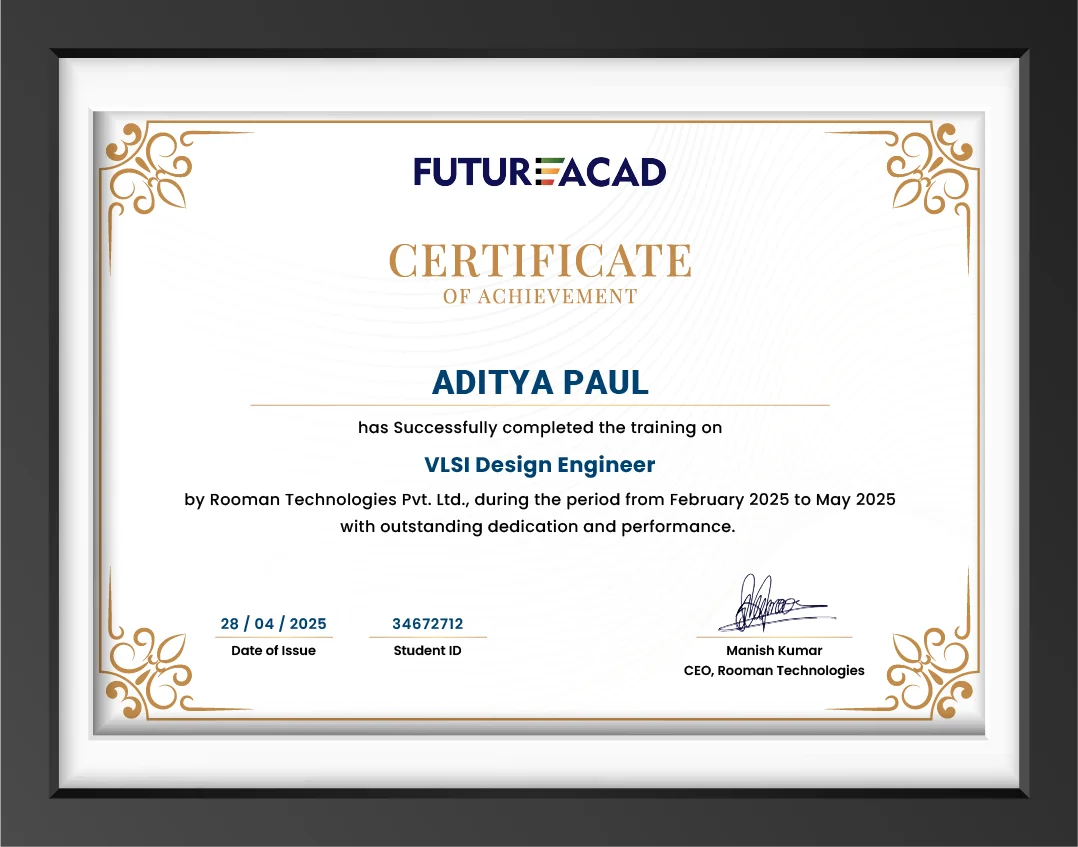
Course Certificate
Eligibility Criteria
- B.E/B.Tech in ECE, EEE, Instrumentation (Final Year or Recent Graduates)
- Have a minimum of 70% marks throughout their academics
- Possess good English communication skills
- Pass the entrance test conducted by Futureacad
Tools & Technologies





Training Options
Online Training
-
Structured, Industry-Vetted Curriculum
-
200+ Practical Assignments & Labs
-
Capstone Projects & Real-Time Simulations
-
Training on Industry-Relevant Tools & Platforms
-
AI-Powered LMS with Lifetime Access
-
Placement Assistance, Career Support & Guaranteed Placements
-
Live, Face-to-Face Mentorship
-
Collaborative Peer Learning
-
Hands-On Experience in Physical Labs
-
Offline Hiring Drives & Resume Building Sessions
Classroom Training
-
Structured, Industry-Vetted Curriculum
-
200+ Practical Assignments & Labs
-
Capstone Projects & Real-Time Simulations
-
Training on Industry-Relevant Tools & Platforms
-
AI-Powered LMS with Lifetime Access
-
Placement Assistance, Career Support & Guaranteed Placements
-
Live, Face-to-Face Mentorship
-
Collaborative Peer Learning
-
Hands-On Experience in Physical Labs
-
Offline Hiring Drives & Resume Building Sessions
Admission Process
Job Readiness Assessment & Communication Test
Clear the qualifier test to be eligible for the program
Complete
Counselling
Only shortlisted candidates go through the counselling
Start
Learning
Unlock your potential with expert-led learning and stand out
Why Join this Program
Earn a job
Receive complete job assistance tailored to your career goals. Get expert placement guidance to confidently step into the industry.
Leverage knowledge from industry experts
Learn directly from seasoned Trainers and Gain real-world insights that go beyond textbooks.
Industry-relevant Tools & Practical Learning
Get hands-on experience with the latest tools used by top companies. Hands-on learning through 200+ exercises and 10+ projects with seamless access to integrated labs.
Structured, industry-vetted curriculum
A curriculum shaped by experts to meet evolving industry demands. Structured learning ensures you're career-ready from day one.
Integrated with Gen AI Modules
The curriculum includes cutting-edge Generative AI modules designed to align with emerging tech trends.
Interview preparation & Placement assistance
Sharpen your interview skills with practical training and expert guidance. Receive complete placement support to connect with top recruiters.